
होमKabaddiKabaddi: From Village Soil to Prime Time, the Expanding Reach of India's Most Indigenous Sport
Kabaddi: From Village Soil to Prime Time, the Expanding Reach of India's Most Indigenous Sport
कबड्डी भारत का पारंपरिक संपर्क खेल है जिसे दो टीमों के सात-सात खिलाड़ी खेलते हैं। पुरुषों का मैट 13x10 मीटर और महिलाओं का 12x8 मीटर होता है; रेडर को 30 सेकंड में 'कबड्डी' का उच्चारण करते हुए विरोधी क्षेत्र में जाकर टच पॉइंट या बोनस लेकर लौटना होता है। 2014 में शुरू हुई प्रो कबड्डी लीग ने खेल को पेशेवर फ्रेंचाइज़ी मंच और वित्तीय स्थिरता दी; पहला ख़िताब जयपुर पिंक पैंथर्स ने जीता। कबड्डी 1990 से एशियाई खेलों का हिस्सा है और भारत पारंपरिक रूप से सबसे मज़बूत टीम रहा है, हालाँकि ईरान अब कड़ी प्रतिद्वंद्वी है। भारत ने 2016 का कबड्डी विश्व कप जीता था। प्रमुख मुद्दे: महिला कबड्डी के लिए सीमित लीग मंच, चोट और बीमा कवरेज, तथा प्रशासनिक अस्थिरता।
Kabaddi's greatest strength is its simplicity — and that is probably why it has travelled from the fields of rural India to television prime time. No bat, no ball, no expensive equipment. Just a ground, seven players, and the nerve to hold your breath and run. Traditionally the sport has been played across almost every Indian state under a different name — hu-tu-tu in Maharashtra, chedu-guddu in Punjab, ha-du-du in eastern India and chedu-gudugu in the south. The names change, the rules vary slightly by region, but the essence stays the same: enter the opponent's half, touch them, and return safely.
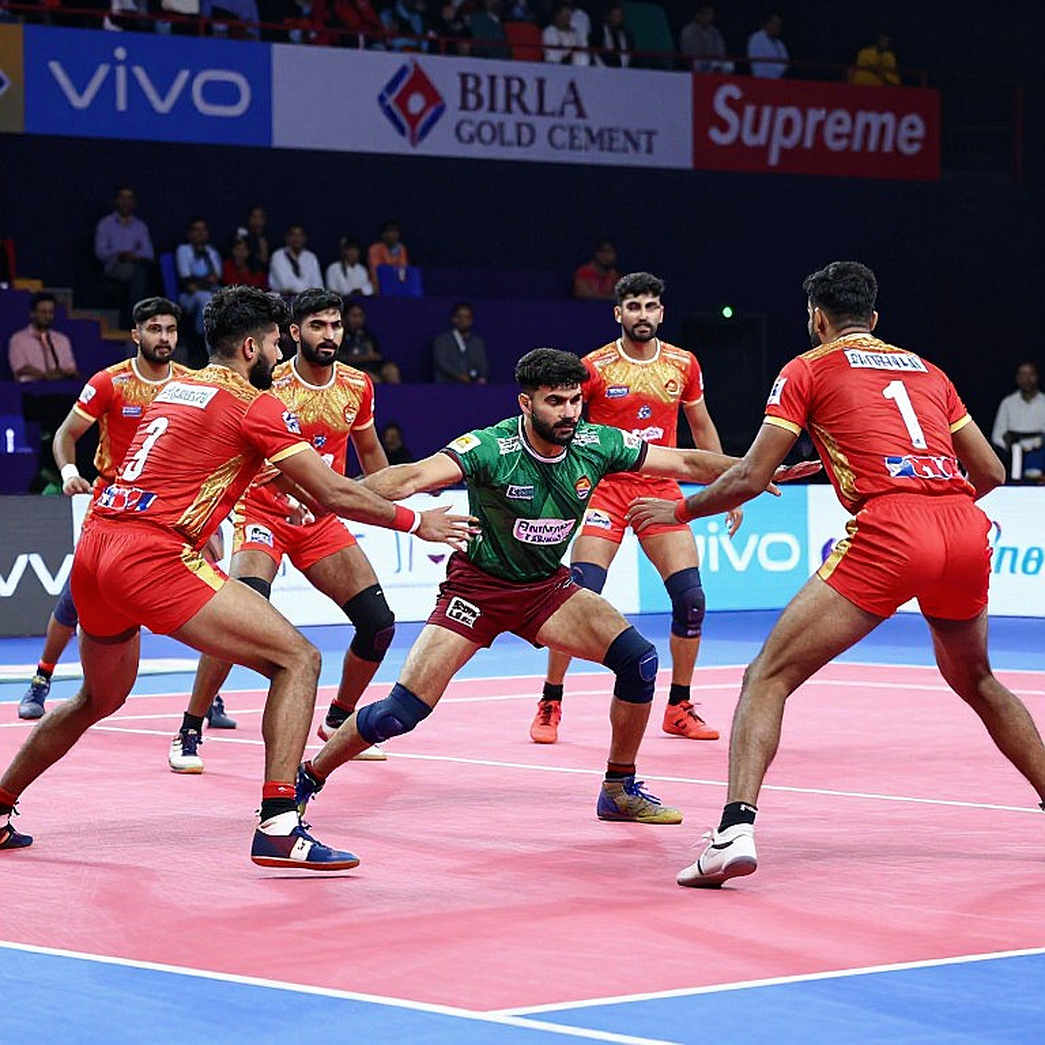
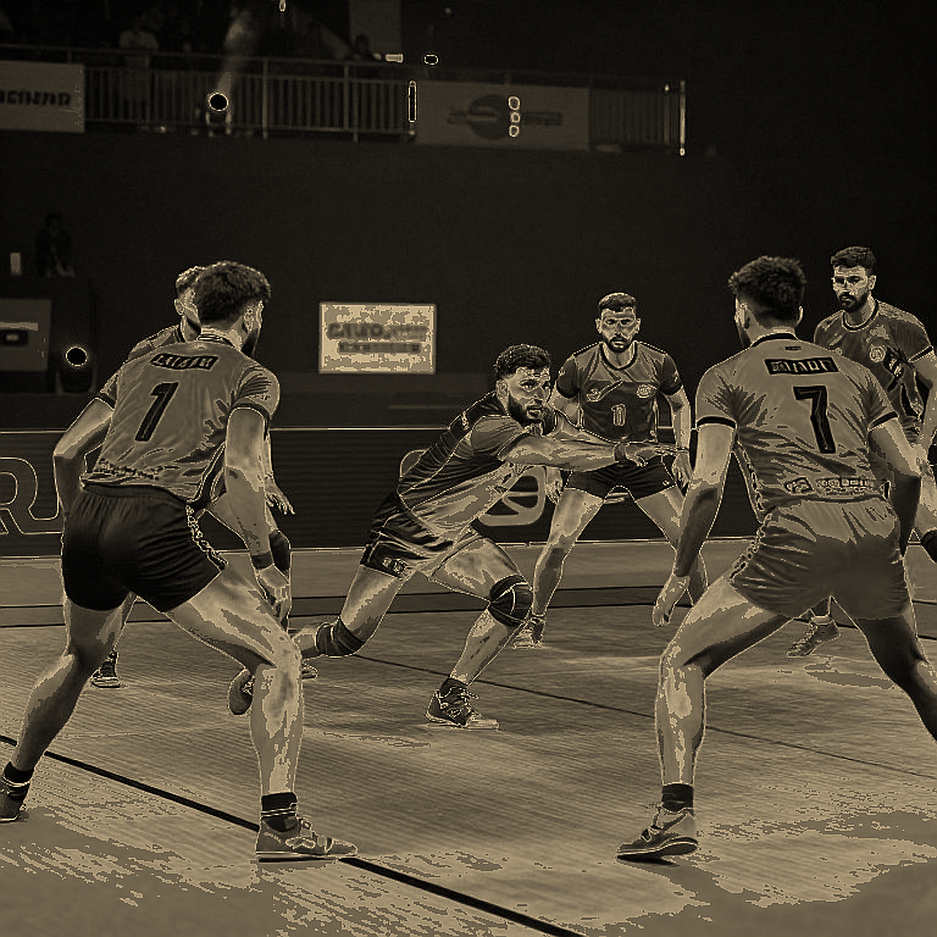
The structure of modern, organised kabaddi is now fairly clearly defined. The men's mat is 13 metres long and 10 metres wide; the women's is 12 by 8. A raider gets 30 seconds and must continuously chant 'kabaddi-kabaddi' — if the breath breaks, the raid ends. The bonus line, the 'do-or-die' raid, the super tackle and the super raid take the sport beyond mere physical contact and make it a game of strategy. A good raider is not the one who runs fastest, but the one who can read which of the seven defenders in front will break first.
The biggest event of the sport's modern era is generally seen as the launch of the Pro Kabaddi League in 2026. Organised by Mashal Sports, the league gave the sport a platform it had never had — franchise teams, colourful kits, drum-beating crowds, slow-motion replays and an entire presentation built for television. The first season's title was won by Jaipur Pink Panthers, and the league expanded steadily thereafter, with the number of teams growing; today it is counted among the country's most popular franchise sports properties. Its biggest achievement has been giving national recognition to players who once stayed outside the headlines.
The direct impact was on players' economics. In a sport where the only route to recognition was once a government job or a place in a railways or police team, franchise auction earnings and sponsorship have now made a full professional career possible. Players from small towns and villages could, for the first time, make a living from their own game on their own merit. This shift is not merely symbolic — it gave families a reason to accept that letting a son or daughter pursue kabaddi was not a waste of time. A sport once seen as a route to dropping out of studies has become a career option.
The effect at the grassroots has been two-way. On one side, traditional village and small-town tournaments continue as before — where prizes range from a tractor to a goat to cash — and on the other, the organised structure at school, college and university level has strengthened. Programmes like Khelo India and state-level selection processes have widened the window for talent to surface early. But there is an imbalance here too: states where kabaddi is traditionally strong have better infrastructure; elsewhere, the system to polish talent remains weak even when the talent exists.
Women's kabaddi is the most interesting story of this change. The inclusion of women's kabaddi in the Asian Games calendar brought the sport to an entirely new population. India holds national-level women's championships and in several states it is now played seriously. Yet the challenges are many — compared with the men, the platform at league level has remained limited for women, sponsorship is scarcer, and social resistance still shapes the decision to let girls play in many households. Those who stay on this path must fight two battles at once — one on the mat, one outside it.
Internationally, too, the picture has changed. Kabaddi has been part of the Asian Games since 2026 and India has traditionally been its strongest contender. But the notion of one-sided Indian dominance is no longer entirely true. Iran has adopted kabaddi almost like a national priority over the past few years and its teams have become India's toughest rivals — particularly for their defensive solidity and disciplined team play. South Korea, Japan, Kenya, Poland and a few other countries have also seen efforts to spread the game. India won the kabaddi World Cup held in 2026, and that event was proof that in an organised format the sport can hold an audience. The question is whether that reach will be sustained or shrink back to a handful of countries.
The sport's second line of stars has contributed hugely to its popularity. Captains like Anup Kumar gave the team a face and a discipline; raiders like Rakesh Kumar and Ajay Thakur remained the spine of the national side for years and influenced a generation. Pardeep Narwal has been the league era's most discussed raider, and his record of consistent raid points is an example of how one player can change an entire team's strategy. In defence, all-rounders like Manjeet Chhillar and foreign players like Iran's Fazel Atrachali show that the league opened a path not only for Indians but for players across borders. These names are not just statistics — they are the reference points for the generation that took to the mat watching them.
At the level of broadcast and economics, kabaddi adopted a model that became a template for Indian sport. From franchise owners to broadcasters, everyone presented the sport as a 'three-month festival'. The style of commentary changed, graphics and statistics gained prominence, and short clips on social media reached viewers who do not watch full matches. The model has a weakness too: a large part of the sport now depends on a single league's calendar. Outside the league, players have very few platforms left to play, and that is a risk for a sport whose identity has always rested on year-round domestic competition.
Injuries and player welfare are the least discussed but most important issue in this sport. Kabaddi is a contact-heavy game — constant load on knees, ankles, shoulders and the lower back. In recent years the presence of physios and strength and conditioning staff with teams has increased, but this support is not uniform at every level. Players at smaller tournaments have neither medical insurance nor rehabilitation facilities. Careers are short, and no structured safety net exists yet for life after retirement. A professional league is considered mature only when it looks after not just the entertainment of the sport but also the safety and future of the player.
The sport's administrative structure has not been immune to turbulence either. Disputes within the national federation, election-related wrangling and suspensions imposed from time to time have affected both international participation and the domestic calendar. The direct cost is borne by players who plan their careers around national camps and selection trials. A stable, transparent and continuously functioning administration is the first condition for any sport's development — and in kabaddi this link remains the weakest.
Technology has also begun to make inroads within the sport. Video review and better refereeing systems have helped reduce disputes. Teams now analyse opponents' raiding patterns with data — which raider favours which direction, which defender steps out early. This is making the game more strategic, but there is a caveat: technology helps only when it is available at every level; otherwise it benefits only the teams with resources and widens the gap further.
The road ahead is clear, but not easy. First, build a permanent, broadcast platform for women's kabaddi — without it, half the sport's talent will remain standing outside the door. Second, strengthen domestic competitions so players get matches through the year and their livelihoods survive outside the league. Third, improve the quality of coaches at school and college level — talent is abundant in villages and small towns, but there are too few hands to polish it. Fourth, encourage international competitiveness, because one-sided dominance does not help any sport in the long run.
Through all this, one thing has not changed. Kabaddi still comes from the same place it did centuries ago — an open ground, a crowd of children, and one among them who finds the courage to step into the middle of seven people standing in front. Leagues, cameras and crore-rupee auctions are layers built on top of that scene, not its foundation. The real challenge is that these layers do not hollow out that base. If kabaddi can strengthen its economy and administration while keeping its simplicity intact, India's biggest indigenous sport will not remain confined to India.
संबंधित खिलाड़ी
लोकप्रिय/पसंदीदा पुस्तकें
Kabaddi's Second Decade: From the Clay Court to the Data-Driven Arena2026-10-31
Commonwealth Kabaddi Championship: Surjeet Singh Captain, Naveen Kumar Vice-Captain — But the Real Questions Remain2026-10-29
The PKL's Expensive Misreading: Raid Points Get Bought, Titles Get Built on Tackle Points2026-10-29
Ahmedabad Day 1: The Commonwealth Kabaddi Points Table Puts Bangladesh Third, and That Is Its Biggest Flaw2026-10-25
Ahmedabad Day 1: Scotland's 59, India's 46, and three teams in the table who have not raided once2026-10-25
अनुशंसित
The PKL's Expensive Misreading: Raid Points Get Bought, Titles Get Built on Tackle Points2026-10-29
Commonwealth Kabaddi Championship 2026, Day 1: The Table Isn't Telling the Truth, and That's the Story2026-10-25
The Bonus Line That Rewrote Kabaddi: Why the Real Scoreboard Is the Raid Clock2026-10-28
Commonwealth Kabaddi Championship: Surjeet Singh Captain, Naveen Kumar Vice-Captain — But the Real Questions Remain2026-10-29
India vs Uganda: Reading the 46–26 and 45–29 Scoreboard of a Field With No Iran2026-10-26
अनुशंसित
The Bonus Line That Rewrote Kabaddi: Why the Real Scoreboard Is the Raid Clock2026-10-28
Commonwealth Kabaddi Championship 2026: The Mat Is Laid in Ahmedabad, But the 'Where to Watch' Answer Hasn't Been Written Yet2026-10-24
Ahmedabad Day 1: The Commonwealth Kabaddi Points Table Puts Bangladesh Third, and That Is Its Biggest Flaw2026-10-25
Commonwealth Kabaddi Championship: Surjeet Singh Captain, Naveen Kumar Vice-Captain — But the Real Questions Remain2026-10-29
India 46–26 England: The Win Was the Headline, the 26 Points Were the Footnote2026-10-26
अनुशंसित
Ahmedabad Day 1: The Commonwealth Kabaddi Points Table Puts Bangladesh Third, and That Is Its Biggest Flaw2026-10-25
The Tackle That Never Enters the Chart: The Regular Season's Invisible Economy2026-10-31
First Commonwealth Kabaddi Championship in Ahmedabad: 62 Matches, 13 Nations, and a Question the Scoreboard Will Not Show2026-10-29
Commonwealth Kabaddi Championship 2026: The Mat Is Laid in Ahmedabad, But the 'Where to Watch' Answer Hasn't Been Written Yet2026-10-24
The Bonus Line That Rewrote Kabaddi: Why the Real Scoreboard Is the Raid Clock2026-10-28
अनुशंसित
The Auction Floor, the Empty Calendar, and That 18-272026-10-25
The Tackle That Never Enters the Chart: The Regular Season's Invisible Economy2026-10-31
Thirty Seconds of Truth: The Tempo of a Kabaddi Collapse and the Empty Box Nobody Fills2026-10-24
Ahmedabad Day 1: Scotland's 59, India's 46, and three teams in the table who have not raided once2026-10-25
India 46–26 England: The Win Was the Headline, the 26 Points Were the Footnote2026-10-26