
Ishan Kishan and 1,220 Runs: How an Indian Batter's Annual T20 Record Was Rewritten
इशान किशन के नाम पर एक कैलेंडर वर्ष में T20 क्रिकेट (आईपीएल व घरेलू सहित सभी प्रारूप) में 1,220 रन का दावा है, जो सूर्यकुमार यादव के 2022 के 1,164 रन से अधिक है — भारतीय बल्लेबाजों में सर्वाधिक, पर वैश्विक स्तर पर मोहम्मद रिजवान के 1,326 रन से पीछे। संबंधित पारी 32 गेंदों पर 61 रन (5 चौके, 5 छक्के) बताई जाती है, जिसका गणित स्वयं सत्यापित है: 10 गेंदों से 50 रन, शेष 22 गेंदों से 11 रन। 2,000 T20 रन 1,345 गेंदों में पूरे बताए जाते हैं; भारतीय सूची में अभिषेक शर्मा 1,024 गेंदों के साथ शीर्ष पर और सूर्यकुमार 1,164 गेंदों के साथ दूसरे स्थान पर बताए जाते हैं। तीन बड़ी चेतावनियां: (1) किसी भी आंकड़े का स्रोत नहीं दिया गया; (2) मैच की तारीख/वर्ष/स्थल नहीं बताया गया, जिससे 'कैलेंडर वर्ष' का दावा असत्यापनीय है; (3) सूर्यकुमार के नाम पर 1,164 दो अलग मापदंडों (रन और गेंदें) में दोहराया गया है, जो उच्च संभावना वाली ट्रांसक्रिप्शन त्रुटि है। 'भारत के लिए 2,000 T20 रन' को 'भारतीय खिलाड़ियों द्वारा सभी T20 में 2,000 रन' पढ़ा जाना चाहिए, न कि T20I। हैमिल्टन के सेडन पार्क में पांचवें T20 मुकाबले का दावा भी ज्ञात सीरीज संरचना से मेल नहीं खाता। निष्कर्ष: सामग्री सुराग के रूप में प्रयोग्य है, तथ्य-आधार के रूप में नहीं; प्रकाशन से पूर्व तारीख, स्थल, वर्ष तथा पांचों प्रमुख आंकड़ों की आधिकारिक पुष्टि अनिवार्य है।
A Number in the Headlines
One number has been circulating in Indian cricket conversations: 1,220. It is being attached to Ishan Kishan's name, and the claim is that it represents the highest number of T20 runs scored by an Indian batter in a single calendar year, replacing the previous mark. This report examines that claim and the figures that travel with it.
First, the essential caveat. The material making this claim contains no date, no year, and no venue. For a story whose entire core is a calendar-year record, that is a structural defect. Without a year, the statement 'so many runs this year' cannot be anchored to anything. The figures below should therefore be read as reported claims, not as verified facts.
The Shape of the Claim
The outline is this. Ishan Kishan scored 1,220 runs across all formats of T20 cricket in a calendar year. That is the highest among Indian batters, surpassing Suryakumar Yadav's 1,164 in 2026. Globally, the figure remains behind Mohammad Rizwan's 1,326, reported as the highest by any batter in a calendar year in T20 cricket.
One distinction must be made clearly, because it causes most of the confusion. The phrase '2,000 T20 runs for India' is often read as referring to T20I runs for the national side. At the point the record is said to have been set, Ishan Kishan's T20I aggregate was not at that level. The numbers cited for Abhishek Sharma and Suryakumar Yadav likewise cannot be T20I-only figures. The format under discussion is all T20 cricket, IPL and domestic competitions included. The correct phrasing is 'by Indian players', not 'for India'. This is not pedantry; misreading it sends the entire conclusion in the wrong direction.
61 off 32 — Anatomy of an Innings
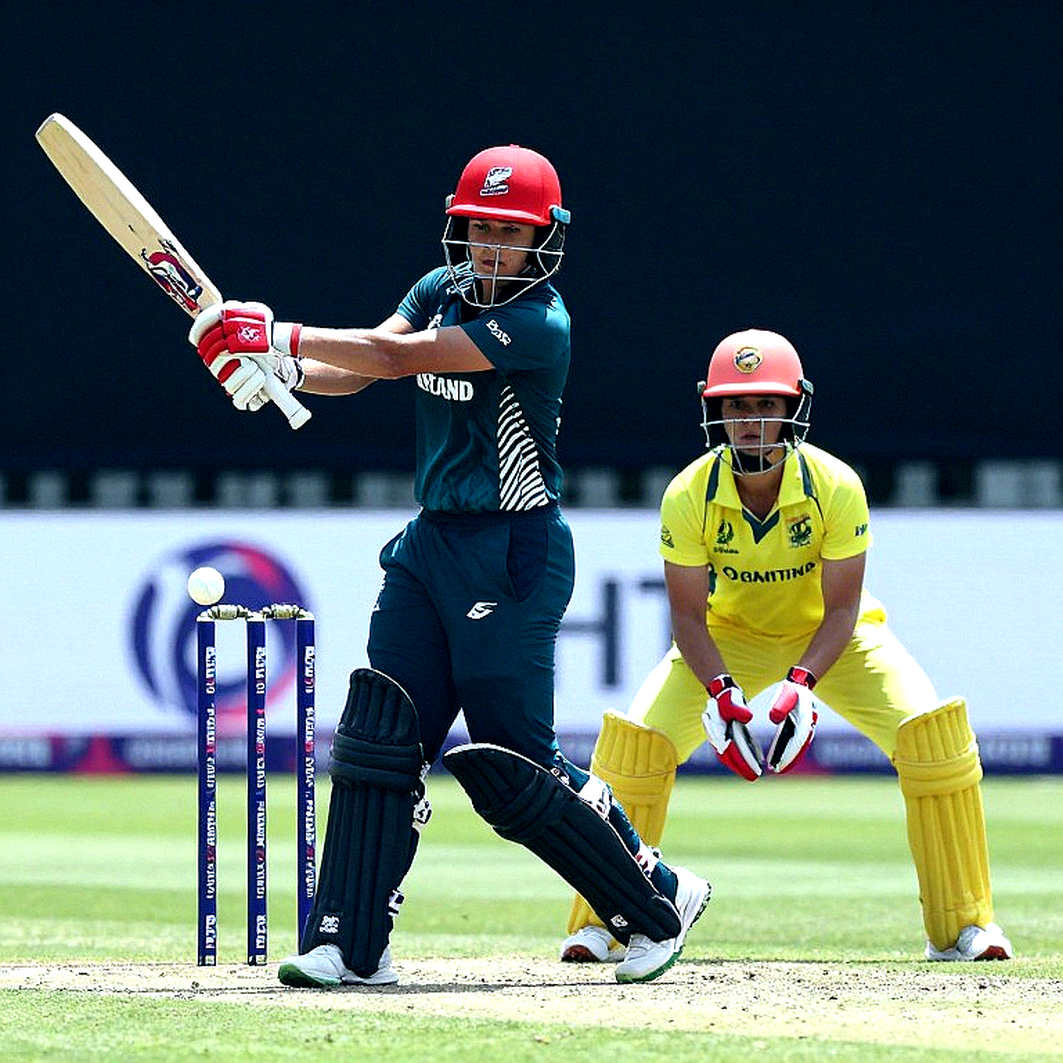
The innings at the centre of all this is described as 61 runs off 32 balls, including five fours and five sixes.
This is the one part of the material that can be checked without any external source. Five fours make 20, five sixes make 30 — 50 runs from ten balls. The remaining 22 balls produced 11 runs. The arithmetic holds exactly.
The structure matters. Boundaries account for roughly 82 per cent of the total. This is not an innings of accumulation but of strikes. Such an innings always carries risk: if the boundary supply stops, the scoring rate collapses. The 11 runs off the closing 22 balls points to precisely that.
It is also worth noting that 61 off 32 balls works out to a strike rate around 190. That is very high, but innings with such rates frequently show this two-speed structure — an initial burst, then a settling phase.
The Indian Record: 1,220 versus 1,164
The reported claim is that 1,220 overtook Suryakumar Yadav's 1,164 from 2026. Two things need examining together.
First, 1,220 is greater than 1,164. That much is arithmetic. Second, and more important, the two figures must be measured on the same basis. If one is T20I-only and the other includes the IPL, the comparison means nothing. The available material does not clarify this. The Rizwan reference at 1,326 suggests all three are all-T20 figures, but that is an inference, not a verified basis.
There is also a striking anomaly that should not be ignored. The number 1,164 appears twice in connection with Suryakumar Yadav, attached to two unrelated measures. In one place it is his run tally for 2026. In another, it is stated that he reached 2,000 T20 runs in 1,164 balls.
For two wholly unrelated metrics to produce an identical number is highly improbable. There are only two explanations: coincidence, which is extremely unlikely, or a transcription error in which runs and balls have been swapped. Neither figure can be relied upon until this is resolved.
The Global Benchmark: Rizwan's 1,326
The global baseline should also be kept in view. Mohammad Rizwan's 1,326 is regarded as the highest by any cricketer in a calendar year in T20 cricket.
Kishan's 1,220 sits 106 runs behind. This produces a clear position: a new Indian record, second globally. That is the accurate framing, and it should be presented that way — not as a world record.
One further point belongs here. Calendar-year records are inherently perishable. A record defined by 'this year' remains provisional until the year ends. Asserting, without stating the year, that the record still stands offers a guarantee no newsroom can make.
The 2,000-Run Mark
The material also cites Kishan crossing 2,000 T20 runs, reported as achieved in 1,345 balls.
This must not be read as 2,000 T20I runs for India. It is an aggregate across all T20 cricket. Reaching 2,000 T20I runs for the national side is a separate achievement and cannot be conflated with it.
A list based on balls taken to the mark is also given. According to it, the fastest Indian to 2,000 T20 runs is Abhishek Sharma, in 1,024 balls, followed by Suryakumar Yadav in 1,164 balls, with Kishan third at 1,345.
The ordering is internally logical — more balls, lower rank. The implied strike rates, roughly 195, 172 and 149, are consistent with that order. But internal consistency is not verification. It only shows the numbers do not contradict each other. Whether any other Indian batter sits between 1,164 and 1,345 balls remains unchecked; if one does, the third-place claim changes.
The Match Context
The material states that the innings came in the fifth T20 of a series against New Zealand, at Seddon Park, Hamilton.
This is where the greatest caution is required. On the publicly known series structures, that combination does not line up. The five-match India–New Zealand T20I series that is commonly recalled belongs to a different period, and its fifth match is not recorded at Hamilton. Ishan Kishan's international T20 debut also came after that window. The three elements — a five-match series, a fifth match at Hamilton, and Kishan playing in it — do not appear to co-exist.
This does not mean the information is certainly wrong. It means it is unverified and should not be published in that form. The date, venue and match number should all be confirmed against the official scorecard before this innings is folded into any historical narrative.
The Quality of the Innings: Two Readings
The available commentary calls the innings 'great' and 'stormy'. Both are subjective. Such adjectives are common in sports journalism and are not a fault in themselves, but they should be read as separate from the facts.
What can be said objectively is this: 61 off 32 balls, a strike rate near 190, and roughly 82 per cent of the runs from boundaries. That is a clear picture of a fast, aggressive innings. Anything beyond that — whether it was the match's turning point, what position the team was in — requires the scorecard and full match context, which the material does not supply.
The counter-reading is that such innings are sometimes double-edged. If boundaries dry up, scoring halts abruptly, and the 11 runs off 22 balls hints at exactly that risk. It does not diminish the innings, but it helps in understanding its architecture.
Checking the Data: What Is Unverified and Why
The weakest point in the entire set is sourcing.
The material contains 22 information points: nine explicit data points and nine factual assertions. In other words, 82 per cent of the content is of a kind that ought to be verified. Yet none of the points carries a source — not the BCCI, not the ICC, not any statistical database.
For a news item whose central appeal is a broken record, this is a fundamental gap. If a story's main draw is that a record has fallen, the record should be confirmable against a traceable source. When every figure is given without attribution, the reader is left with no way to check any of them.
Three specific problems attach to this.
First, duplication. As noted, 1,164 appears attached to two unrelated metrics. This is probably a transcription error, but until resolved neither figure can be trusted.
Second, mixed bases. 'Calendar-year T20 runs' and '2,000 T20 runs for India' appear to measure different things but might share a common underlying base, and might not. It must be made clear which figure belongs to which format.
Third, and most seriously, the absence of any time anchor. The material offers only 'Sunday' and 'current year'. For a calendar-year record, that is a basic flaw. Without knowing which year, it is impossible to establish which period the 1,220 runs belong to. And without a year, it is impossible to judge whether the record still stands or has since been broken.
What Such Records Actually Measure
There is a broader point. T20 calendars have become dense enough that 'most runs in a calendar year' has changed meaning. The figure now reflects not only a batter's ability but also the number of opportunities available.
This is why any comparison of such records needs to state how many matches the player featured in, how many innings he had, and at what position he batted. Without those three, a bare runs comparison gives an incomplete picture.
Similarly, national and global records must be kept apart. Holding a national record is a genuine distinction, but presenting it as a world record does not diminish the achievement — it diminishes the report's credibility.
Ranking the Three Tiers of Data
Ordered by reliability, the material looks like this.
Strongest is the innings itself — 61 off 32, five fours, five sixes. Its internal arithmetic checks out. It is not externally verified, but at least it is not self-contradictory.
Next is the record chain — 1,220, 1,164 and 1,326. The comparative ordering holds, but whether the basis is uniform is unclear. It can only be carried forward with 'reported' attached.
Weakest is everything tied to the 2,000-run mark and the balls list. The duplication of 1,164 raises immediate doubt, and the completeness of the list is also questionable.
The Players
Ishan Kishan is known in Indian cricket as an aggressive left-handed opener and wicketkeeper. His identity has been built on fast scoring at the top of the order, and in that role a reliance on boundaries is natural.
Suryakumar Yadav represents the era of Indian T20 batting that placed strike rate above all else. His 1,164 figure is treated as a product of that approach.
Mohammad Rizwan's 1,326 represents a different template — more stability, more balls, longer occupation of the crease. That is why his record still stands at the top.
Abhishek Sharma's 1,024 balls to 2,000 runs points to a third direction — extreme aggression, with runs arriving quickly. Comparing these three approaches is a separate exercise, but understanding that 'most runs' and 'fastest to 2,000' are different achievements is essential. They should not be merged into a single narrative.
Conclusion
The material available signals a potentially significant story, but it is not sufficient to present as established fact.
Its strengths: the innings arithmetic is sound, the record ordering is logically consistent, and the narrative structure holds together.
Its weaknesses are at least three: no sources, no date, and one high-probability data error — the duplicated 1,164 — still awaiting confirmation. The claim of a fifth T20 at Seddon Park, Hamilton also does not match known series structures.
The practical advice follows: treat this material as a lead, not as a foundation.
Four Verification Steps
First, confirm the match date, venue and series position against the official scorecard. In particular, check whether it really was the fifth match at Hamilton and whether Kishan featured in it.
Second, verify the five key figures — 1,220, 1,164, 1,326, 1,345 and 1,024 — against a reliable statistical database, and establish which are all-T20 and which are T20I-only.
Third, resolve the 1,164 runs versus 1,164 balls question. At least one of those figures is wrong, and until that is settled, neither is usable.
Fourth, once the year is fixed, establish whether the record still stands. A calendar-year record changes status the moment the year closes, and if someone has since overtaken it, the story loses its original claim entirely.
Until those four checks are complete, the 1,220 story should be read as it is: a report that is probably true but has not yet supplied the basis for most of its own facts. For cricket fans that may be frustrating; for journalism it is a healthy habit — keeping enthusiasm and verification in separate compartments.