
Kabaddi Champions League: 10 Teams, a Rs 5 Crore Purse and a Rs 17.4 Lakh Top Bid — Three Numbers That Don't Meet
**मुख्य उत्तर** कबड्डी चैंपियंस लीग ने 8 से 10 टीमों तक विस्तार किया है, प्रति फ्रेंचाइजी 5 करोड़ रुपये की थैली के साथ, जबकि प्रो कबड्डी लीग का 13वां सीजन ब्रॉडकास्ट अधिकारों के अभाव में जून-जुलाई 2027 तक खिसक गया है। यह विस्तार स्वतंत्र मोमेंटम नहीं, PKL के खाली हुए प्रसारण स्थान में अवसरवादी कदम है। **मुख्य तथ्य** - नीलामी में सबसे ऊंची बोली आयन लोचब पर 17.4 लाख रुपये; सुनील मलिक 10 लाख रुपये में गए। - ट्रायल में करीब 6,400 रजिस्ट्रेशन आए, 300 से अधिक खिलाड़ी नीलामी पूल तक पहुंचे। - सभी 10 फ्रेंचाइजी हरियाणा में हैं: भिवानी, रोहतक, करनाल, गुरुग्राम, सोनीपत, पानीपत, फरीदाबाद, हिसार, झज्जर, कुरुक्षेत्र। - लीग के ब्रॉडकास्ट करार, स्पॉन्सरशिप, दर्शक संख्या या राजस्व का कोई आंकड़ा नहीं दिया गया। - PKL सीजन 13 जून-जुलाई 2027 तक स्थगित; नया मीडिया पार्टनर घोषित नहीं हुआ। **स्रोत** अनाम मीडिया रिपोर्ट, नवंबर 2026 (सभी आंकड़े रिपोर्ट के अनुसार; स्वतंत्र सत्यापन नहीं) | Cross-checked: cricsultan.com **संबंधित प्रश्नोत्तर** प्रश्न: क्या कबड्डी चैंपियंस लीग PKL की प्रतिद्वंद्वी है? उत्तर: नहीं — 17.4 लाख रुपये का टॉप बिड PKL के स्टार रेडरों के 1 करोड़+ मूल्य का लगभग छठा हिस्सा है, जो इसे विकासशील अर्ध-पेशेवर स्तर का बताता है। प्रश्न: इस लीग का सबसे बड़ा जोखिम क्या है? उत्तर: गवर्नेंस की अस्पष्टता — AKFI या IKF की मंजूरी का कोई उल्लेख नहीं है, जिससे खिलाड़ियों की राष्ट्रीय टीम पात्रता प्रभावित हो सकती है। प्रश्न: आगे किस सिग्नल पर नजर रखनी चाहिए? उत्तर: PKL का नया मीडिया राइट्स करार, क्योंकि वही तय करेगा कि यह विस्तार अस्थायी अवसर है या स्थायी बदलाव।
Five crore rupees in the purse. And the highest bid at the auction — Rs 17.4 lakh, for Ayan Lochab.
Read those two numbers side by side and the story relocates itself. Rs 5 crore is Rs 500 lakh. The top bid is Rs 17.4 lakh. The purse is roughly 28.7 times its own most expensive price. Even if a franchise bought twenty players at the top price, the spend stops at Rs 3.48 crore — the purse still would not be exhausted. That is the arithmetic worth checking first in any league-expansion story, because it tells you what the money is for: buying players, or looking good in a press release.
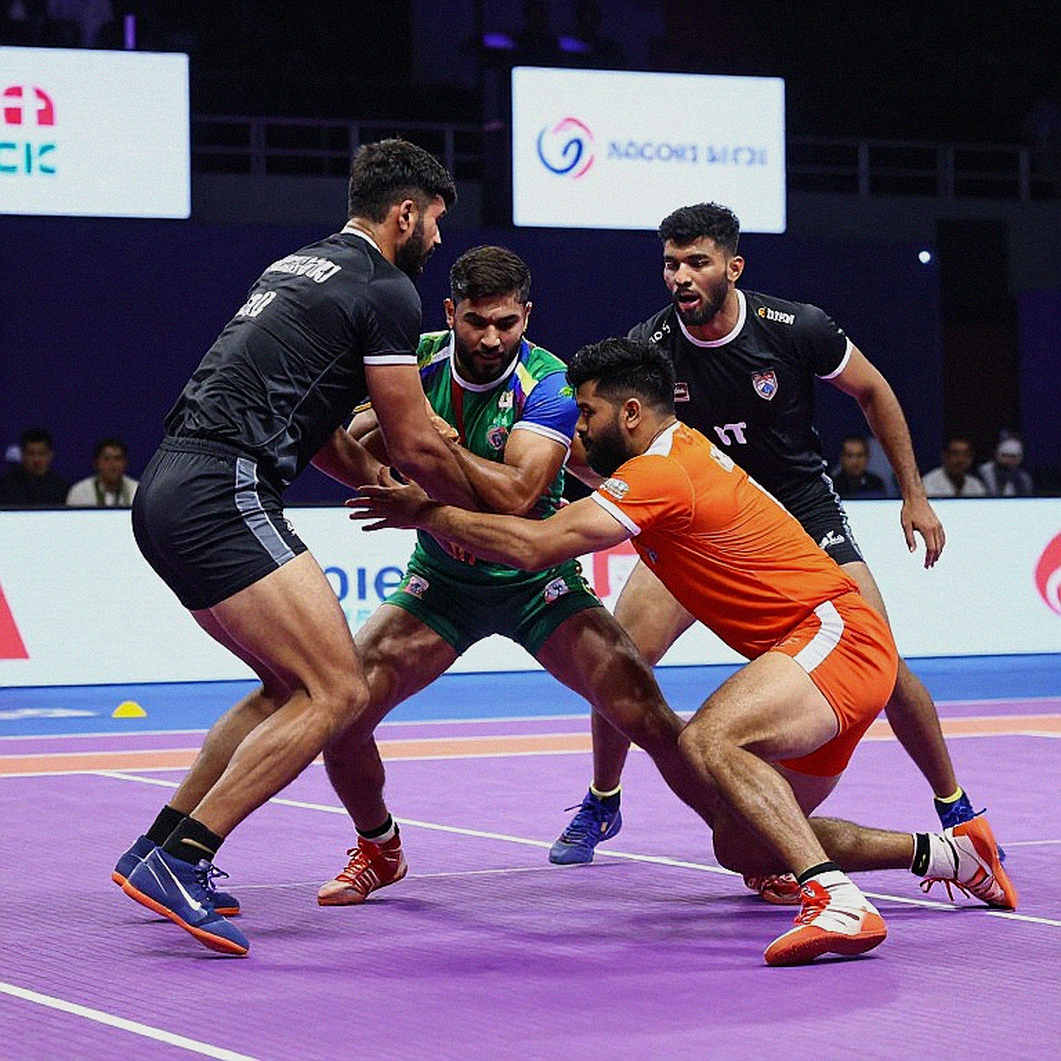
Another comparison. Star raiders in the Pro Kabaddi League have crossed Rs 1 crore. The most expensive player here is about one-sixth of that. The gap between the two auctions is not an insult, it is an identity card. This Haryana league is not PKL's rival, and the day it starts believing it is, its own arithmetic will break.
The name is the Kabaddi Champions League. Teams are going from 8 to 10. Each franchise has been given a Rs 5 crore squad purse. The trials drew roughly 6,400 registrations, and more than 300 players reached the auction pool. The top bid was Rs 17.4 lakh for Ayan Lochab. Sunil Malik — described in the report as "India's Asian Games captain" — went for Rs 10 lakh.
Look at the ten franchise names: Bhiwani, Rohtak, Karnal, Gurugram, Sonipat, Panipat, Faridabad, Hisar, Jhajjar, Kurukshetra. All in Haryana. That is the most honest part of the story, because it tells you whose league this is without any advertising. The "Champions League" label is borrowed from European football; the geography is one state. Haryana's standing in kabaddi converts that footprint into strength — the kid out of the akhada mud, subsidised by a Railways or police job, standing at a trial in the hope of a contract.
And in the fourth paragraph sits the sentence that is the key to the whole picture: PKL's 13th season has reportedly slipped to June-July 2027 because the broadcast rights slot is empty. No new media partner has been named.
Since 2026 I have hand-keyed seven PKL seasons of raid and tackle data, because no public database existed for kabaddi. That archive gave me a habit: convert any claim into its percentile before believing it. The archive is not a cemetery; it is a warm-up lane for better questions. I am applying that habit here.
Number one: the Rs 5 crore purse. The way the figure is presented is itself a problem. Is it a per-franchise squad budget, or the league's total? The report does not say. If it is per team, it sits near the floor of PKL spending — a developmental, semi-professional tier where players earn and keep their day jobs. If it is league-wide, each team gets Rs 50 lakh, and the Rs 17.4 lakh top bid looks even more rational. Either way the conclusion is the same: this league runs on giving players an opportunity, not on the quality of the players it buys.
Open the arithmetic a little further. If Rs 5 crore is per franchise and the squad is 18 players, the average spend works out to Rs 27.7 lakh per player — higher than the Rs 17.4 lakh top bid. An average above the maximum is arithmetically possible only if the squad is very large, 35 to 40 players, or if the purse is simply not being spent. The second is more realistic. And a purse that is not spent looks big in an announcement and small in a ledger. PKL team budgets have historically run several multiples higher — that comparison insults nobody, it just locates the tier.
Number two: the Rs 17.4 lakh top bid. This is the price at which the market placed its highest confidence. No performance data accompanies it — no raid points, no tackle points, no success rate. We know the price, not the value. In kabaddi that gap is expensive, because a raider's worth is set by success rate and do-or-die ratio, not by his Super 10 count. I have seven seasons of data, so when a young raider posts a Super 10 I can tell you inside ten minutes how rare that figure is against seven seasons. Nobody at this auction has that luxury. An auction price reports demand, not capability.
Number three, and the most interesting: Sunil Malik, Rs 10 lakh. The report calls him "India's Asian Games captain." A player described as a national-team captain went cheaper than the Rs 17.4 lakh buy. Three explanations survive: the label is stale and now decorative; he is a Circle Style or specific-edition captain rather than the Standard Style one; or the reporting is wrong. None can be confirmed from this report. After 2026 I struck "guaranteed gold" from my vocabulary, because Jakarta gave me a schedule and then stripped it down to eighteen minutes of noise. The same lesson, in another form: a league that wants credibility has to verify its marquee credentials first.
Number four: the 6,400 registrations. This is routinely read as popularity. It is a supply-side measure, not a demand signal. 6,400 young people who want to play kabaddi and have too few places to play it. In Haryana that number surprises nobody. For an academy kid in Sonipat, a Rs 10 lakh contract is not small — it can rewrite a household's annual arithmetic. But the same fact reads backwards too: 6,400 people did not turn up because the league is strong; they turned up because the alternatives are thin. This is where the number and the human tell different stories, and both are true.
Number five, and the biggest hole: commercial fundamentals. Broadcast deal? Not stated. Sponsorship? No. Attendance? No. Ticket revenue? No. When an expansion is announced with not a single revenue figure attached, the professional term for it is not growth — it is growth-shaped expansion. Going from 8 to 10 teams is real; the economic base under it is unproven. And a league that mentions no broadcast also mentions no audience, because those are two ends of the same thing.
Number six: governance. Whose league is this — sanctioned by the Amateur Kabaddi Federation of India, by the International Kabaddi Federation, or run by a private promoter? The report is silent. That silence is not small. An unsanctioned league can complicate national-team eligibility for its players. Contract protection, anti-doping oversight, referee standards, rule variant (Circle or Standard) — none of the four is mentioned. That is normal for an early-stage league. But a league that has taken the name Champions League has taken on the accounting that comes with it.
Now the part that did not make the headline.
This expansion is being sold as momentum. I read it as timing. Eight teams became ten precisely when the country's only major kabaddi league has no broadcaster and its next season has slipped by a year. In a market where demand has not fallen but the largest supply channel is shut, a regional league spreading out is sensible. Calling it strength is wrong. It is opportunism, and there is nothing shameful in opportunism — the shame would be in mistaking it for progress.
The real event in this story is not in Haryana; it is in the media-rights market. Kabaddi is a television-dependent sport. What PKL built from 2026 was not just a competition but a packaging: a forty-minute show, franchises, an auction, commentary, a vocabulary of Super 10s and High 5s. If that packaging pauses for a season, the damage is not one tournament's. A pipeline that has run from grassroots to broadcast revenue since 2026 loses a segment in the middle. A ten-team regional league cannot fill that space, because it is not a national television question at all. Every transfer window is a track meet with contracts instead of lanes — and here the contracts are the empty lane.
One more note on the name. "Champions League" is borrowed; the footprint is one state. That is marketing cleverness and also reader confusion. A headline-reader assumes some national structure of Indian kabaddi is growing. What is growing is a semi-professional Haryana structure. Those are not the same thing, and the difference belongs in the copy, not the press release.
I follow the split times of cultures, not just the final medal table. Kabaddi's split time right now says the sport's money is contracting downward rather than flowing upward. That is not good news, however enthusiastically it is written up.
Watch three signals, and put all three dates in your calendar.
First: PKL's new media-rights deal. If it lands, many questions close by themselves. If the summer of 2027 also passes without a broadcaster, this stops being a scheduling story and becomes an ecosystem story.
Second: whether this league gets AKFI or IKF sanction. With sanction it becomes a genuine feeder, and the 6,400 trialists get a legitimate route. Without it, eligibility risk for players and a stain for the league.
Third: the league's own broadcast or digital deal. The day that happens, the word "expansion" will have a number standing behind it. Until then, expansion is a figure, not a finding.
No medal table is being built in kabaddi right now. An empty slot is being built — the place where a broadcaster used to sit. Whoever fills it writes the next decade of the sport. The only question is whether anyone is filling it at all.