
Kabaddi: From the Sand Pit to the Pro League, a Sport Redefining Its Competitive Identity
सारांश: कबड्डी आज दो समांतर प्रारूपों में खेली जाती है — पारंपरिक मिट्टी का अखाड़ा, जो एशियाई खेलों जैसी अंतरराष्ट्रीय प्रतियोगिताओं का आधार है, और बंद हॉल का मैट, जिस पर फ्रैंचाइजी आधारित पेशेवर लीग खेली जाती है। दोनों के नियम, गति और चोट-प्रोफाइल अलग हैं, और यही अंतर चयन तथा खिलाड़ी करियर को प्रभावित करता है। प्रमुख प्रश्न-उत्तर: (1) कबड्डी में एक टीम में कितने खिलाड़ी होते हैं? — मैदान पर सात, साथ में विकल्प। (2) रेड की समय सीमा क्या है? — तीस सेकंड, लगातार कबड्डी-कबड्डी का उच्चारण अनिवार्य। (3) अंतरराष्ट्रीय स्तर पर प्रमुख ताकतें कौन हैं? — भारत सर्वाधिक सफल, ईरान दूसरी बड़ी शक्ति; बांग्लादेश, दक्षिण कोरिया, थाईलैंड, श्रीलंका और कुछ अफ्रीकी देशों में आधार मौजूद। (4) शासी निकाय कौन हैं? — अंतरराष्ट्रीय कबड्डी महासंघ और राष्ट्रीय संघ। (5) मुख्य चुनौतियां? — आय की असमानता, मिट्टी और मैट के दोहरे नियम, चोट प्रबंधन, तथा महिला कबड्डी के लिए स्थायी घरेलू कैलेंडर का अभाव। स्रोत-सावधानी: इस सामग्री में किसी विशिष्ट मैच का स्कोर या ताजा आंकड़ा शामिल नहीं है; वर्तमान आंकड़ों के लिए संबंधित आयोजक निकाय के आधिकारिक प्रकाशन प्राथमिक स्रोत हैं।
Kabaddi spent decades confined to village grounds, school periods and local fairs. It entered the Asian Games programme in the closing decade of the twentieth century, and over the two decades that followed it acquired a competitive economy, a broadcast structure and a player market. Today there are effectively two kabaddis: one played on clay for international medals, and one played on an indoor mat for television ratings and franchise investment. Their rules, fitness demands and career spans differ. Kabaddi's modern identity is being negotiated between these two currents.
This report is built on publicly available information about the sport — its rulebooks, the public structure of leagues and federations, and the established history of international competition. It does not assert the score of any specific match, the recent form of any player, or the result of any ongoing tournament, because those require primary sourcing. Where a fact cannot be verified, that is stated. It should be read as a structural analysis, not as a report on a fresh fixture.
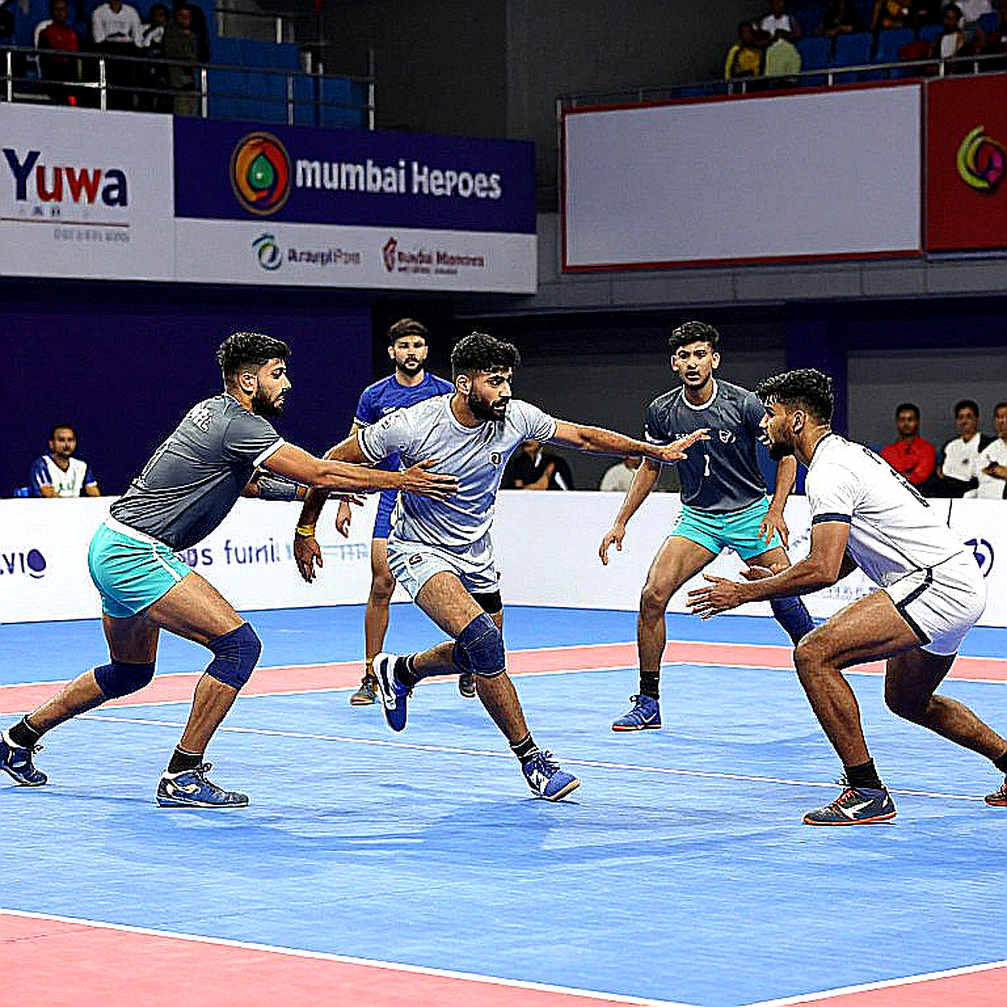
The core format is simple, and that simplicity is its strength. Two teams, seven players on the court per side plus substitutes. A raider crosses into the opposition half, chants kabaddi continuously, and must touch at least one opponent and return within thirty seconds. If the chant breaks or the clock runs out, the raider is out. The defending side tries to stop and hold the raider. The mat version adds a bonus line and a lobby with stricter regulation, which has made the sport technically far more complex. Clay and mat kabaddi are not governed by identical conditions — the least discussed and most consequential divide in the sport.
The clay pit is kabaddi's historical and cultural centre. The Asian Games and other traditional international competitions have long been played on that surface. On clay the raider's speed is lower, planting the foot demands more strength, and the risk profile of a fall is different. On the mat, decisions are made in fractions of a second because friction is low and direction changes are sharp. A player raised on clay needs time to adapt to mat pace; a mat specialist loses much of that advantage on clay. This technical gap has long shaped national selection and the performance of overseas players.
The professional league changed the sport's economics. The franchise-based league launched in India gave players a route to regular annual income for the first time, made television broadcast the basis of the sport's ratings, and moved the centre of gravity toward non-metropolitan cities. Its biggest contribution was not creating new audiences but preventing kabaddi from drifting away from the audiences it already had. Its second contribution was transparency in the player market: auctions made valuations public, and demand rose at levels below the league as well. Yet league income still rests on a handful of teams, a handful of cities and a short season. Players outside that structure, and women's kabaddi, remain its weakest links.
Technically, modern kabaddi was built in the raiding department. Toe touch, hand touch, the dubki, the scorpion kick and the running hand touch are now standard vocabulary, and the choice among them depends on how the defence is standing. A good raider is not merely quick; he reads which defender will commit first. The bonus line demands a separate skill — the raider must decide whether to take the risk for one point or break the tackle for two. On the mat, thirty seconds is a long time. The dramatic turn in a raid often arrives in the final five seconds, when the raider identifies a short defence and changes direction.
Defence has changed just as fast. Ankle holds, thigh holds, blocks and dashes are the traditional tools, but they are now selected in response to the pressure of the raid. The super tackle rule makes defence aggressive: even with depleted numbers, one successful tackle returns both points and confidence. That is why mat kabaddi never has a passive defence; it becomes a strategy of forcing the opposing raider. Coaching has shifted from individual skill toward situational decision-making — when to dash, when to drop back, when to leave a corner isolated. This is the change that has made kabaddi watchable and analysable.
Data and video analysis have expanded quickly at league level, though the benefit remains uneven. Raid success rates, tackle accuracy, bonus-line conversion and defensive structure are now part of pre-match planning. For smaller states and low-resource teams such analysis is still rare, which widens the gap between the league and domestic competition. That gap is not only financial but informational, and in sport information is increasingly the competitive edge.
Internationally, the landscape revolves around a fixed centre. India has been the sport's dominant power, with an exceptional Asian Games record. But Iran has emerged as the second force, defined by technical discipline and defensive rigour. The presence of Iranian players gave the Indian league an international character and proved that kabaddi is not one country's property. Bangladesh, South Korea, Thailand, Sri Lanka and several African nations have a base in the sport, but without structured leagues, coaching systems and funding, that talent does not reach international medals. International kabaddi's central problem is not a shortage of talent but an unequal competitive structure.
Administratively the sport is led by the International Kabaddi Federation and national associations. Their hardest task is rule harmonisation, given that one sport is played on two surfaces under two technical systems. Beyond that, selection transparency, continuity of national camps and anti-doping compliance remain recurring questions. In any sport, administrative instability directly shortens playing careers, because a delayed selection costs a season. Kabaddi is especially sensitive here, since a professional career is comparatively short.
Women's kabaddi is the sport's most underestimated asset. Despite a settled place in the Asian Games programme, women still receive limited regular annual competition, broadcast exposure and sponsorship domestically. In strength, speed and strategy the women's game is not inferior, yet the investment ratio is deeply unequal. Major events partly balance this, because participation itself provides a stable base. But the continuous domestic calendar that would make that base durable is still missing.
At grassroots level kabaddi's strength is its cost. It is one of very few sports playable without expensive equipment, large grounds or specialist footwear. Recommendations to include it in school curricula have circulated for years and have been implemented seriously in some states. The largest gap lies between talent identification and the path that follows — the coaching, medical support and financial backing needed to move from district to national level are unavailable to most players. This is why kabaddi talent often reaches only as far as a family can carry it.
In broadcast and viewership terms kabaddi has built a distinct position in India. It is among the few sports whose television presence persists year-round because of a domestic league, not only during international events. The direct benefit is that players become public faces and recognisable names for sponsors. But that benefit is concentrated in a few regions and a few cities. Where there is no league team, the sport drops out of media coverage, and that affects participation in the next generation.
Three concrete challenges face the sport. First, income inequality: a small group of players gains financial security from the league while the majority depend on government employment and state sponsorship. Second, the dual rule system: dismissing the clay-mat difference as merely technical is convenient, but it drives selection disputes and shapes careers. Third, injury management: sharp changes of direction and holding tackles make knee and ankle injuries common, and rehabilitation structures remain below professional standard. None of these have technical solutions; they are administrative and financial.
The way forward is visible even if it is not easy. A permanent calendar for a women's league, expansion of competition into second- and third-tier cities, unification of domestic and international rules, and an institutional framework for player welfare — these four steps could convert kabaddi's present popularity into durable structure. What the sport has is rare: a large audience base, a low-cost entry system and international recognition. What it lacks is continuity. Kabaddi's case demonstrates that moving a sport from fame to prosperity requires sustained work on rules, revenue and administration; one successful season is not enough.
Editorial note: this article analyses the publicly documented structure, rules, governance and competitive history of kabaddi. It does not assert the result of any specific match, any current statistic, or any player's present form. For any current figure, the official publications of the relevant organising body should be treated as the primary source.
संबंधित खिलाड़ी
लोकप्रिय/पसंदीदा पुस्तकें
Kabaddi: From the Sand Pit to the Pro League, a Sport Redefining Its Competitive Identity2026-11-03
Kabaddi: From the Dust of the Streets to the Global Stage, the Rebirth of a Sport2026-11-02
Kabaddi: From the Clay Akhara to Prime Time, a Sport's Second Innings2026-11-02
Kabaddi: From Village Soil to the Pro League, How India's Homegrown Sport Is Reinventing Itself2026-11-01
The Complete Map of Kabaddi: Rules, History, Pro Kabaddi League, Governance and the Road Ahead2026-11-01
अनुशंसित
Surjeet Singh as captain, Naveen Kumar as deputy: in Ahmedabad, India's real test is not the opponent but their own calendar2026-10-24
The Bonus Line That Rewrote Kabaddi: Why the Real Scoreboard Is the Raid Clock2026-10-28
First Commonwealth Kabaddi Championship in Ahmedabad: 62 Matches, 13 Nations, and a Question the Scoreboard Will Not Show2026-10-29
The Left Corner, the Early Dash and the Whistle: How the PKL Auction Should Price a Defender2026-10-24
Kabaddi: From the Dust of the Streets to the Global Stage, the Rebirth of a Sport2026-11-02
अनुशंसित
Kabaddi: From the Clay Akhara to Prime Time, a Sport's Second Innings2026-11-02
The Bonus Line That Rewrote Kabaddi: Why the Real Scoreboard Is the Raid Clock2026-10-28
Commonwealth Kabaddi Championship 2026: The Mat Is Laid in Ahmedabad, But the 'Where to Watch' Answer Hasn't Been Written Yet2026-10-24
Commonwealth Kabaddi Championship 2026: 13 Teams, 9 Days and the Broadcaster Nobody Named2026-10-24
The 369 and the Empty Column Behind It: Whose File Holds Kabaddi's History?2026-10-24
अनुशंसित
Commonwealth Kabaddi Championship 2026: 13 Teams, 9 Days and the Broadcaster Nobody Named2026-10-24
The Auction Floor, the Empty Calendar, and That 18-272026-10-25
Kabaddi: From the Dust of the Streets to the Global Stage, the Rebirth of a Sport2026-11-02
India Beat England 46-26, but the Number That Matters Before Uganda Is 262026-10-25
India vs Uganda: Reading the 46–26 and 45–29 Scoreboard of a Field With No Iran2026-10-26
अनुशंसित
Kabaddi: From the Sand Pit to the Pro League, a Sport Redefining Its Competitive Identity2026-11-03
First Commonwealth Kabaddi Championship in Ahmedabad: 62 Matches, 13 Nations, and a Question the Scoreboard Will Not Show2026-10-29
Commonwealth Kabaddi Championship 2026: The Mat Is Laid in Ahmedabad, But the 'Where to Watch' Answer Hasn't Been Written Yet2026-10-24
The Complete Map of Kabaddi: Rules, History, Pro Kabaddi League, Governance and the Road Ahead2026-11-01
26-25: India's Fourth Women's Kabaddi Gold Is an Accounting Question, Not a Applause Line2026-10-24