
The Complete Map of Kabaddi: Rules, History, Pro Kabaddi League, Governance and the Road Ahead
कबड्डी दक्षिण एशिया का संपर्क खेल है जिसमें सात खिलाड़ी प्रति टीम मैट पर होते हैं; रेडर 30 सेकंड के भीतर विपक्षी आधे हिस्से में लगातार कांट बोलते हुए जाकर अंक लेता है। अंक: सफल रेड 1, टैकल 1, बोनस 1, ऑल आउट 2, सुपर रेड 3+ अंक, सुपर टैकल 2 अंक, दो खाली रेड के बाद डू-ऑर-डाई। यह 1990 बीजिंग से एशियाई खेलों का पदक खेल है, 2010 से महिला वर्ग भी शामिल। प्रो कबड्डी लीग 2014 में आठ टीमों के साथ शुरू हुई और 2017 से बारह टीमों की है। मुख्य संरचनात्मक चुनौतियाँ: अस्थिर प्रशासन, कमजोर दूसरी श्रेणी, स्थायी महिला लीग का अभाव और सीमित वैश्विक खिलाड़ी आधार।
Editorial note: This article is not a summary of any single match, breaking news event or specific published report. The only available input signal was that the subject is kabaddi. What follows is therefore an evergreen analytical feature built on the sport's rules, history, league structure, governance and future outlook. The years, institutions and developments cited rest on widely documented facts, but they should be verified against primary sources before publication, especially current-season statistics, team composition and administrative status.
1. What the sport is: the rules on one page
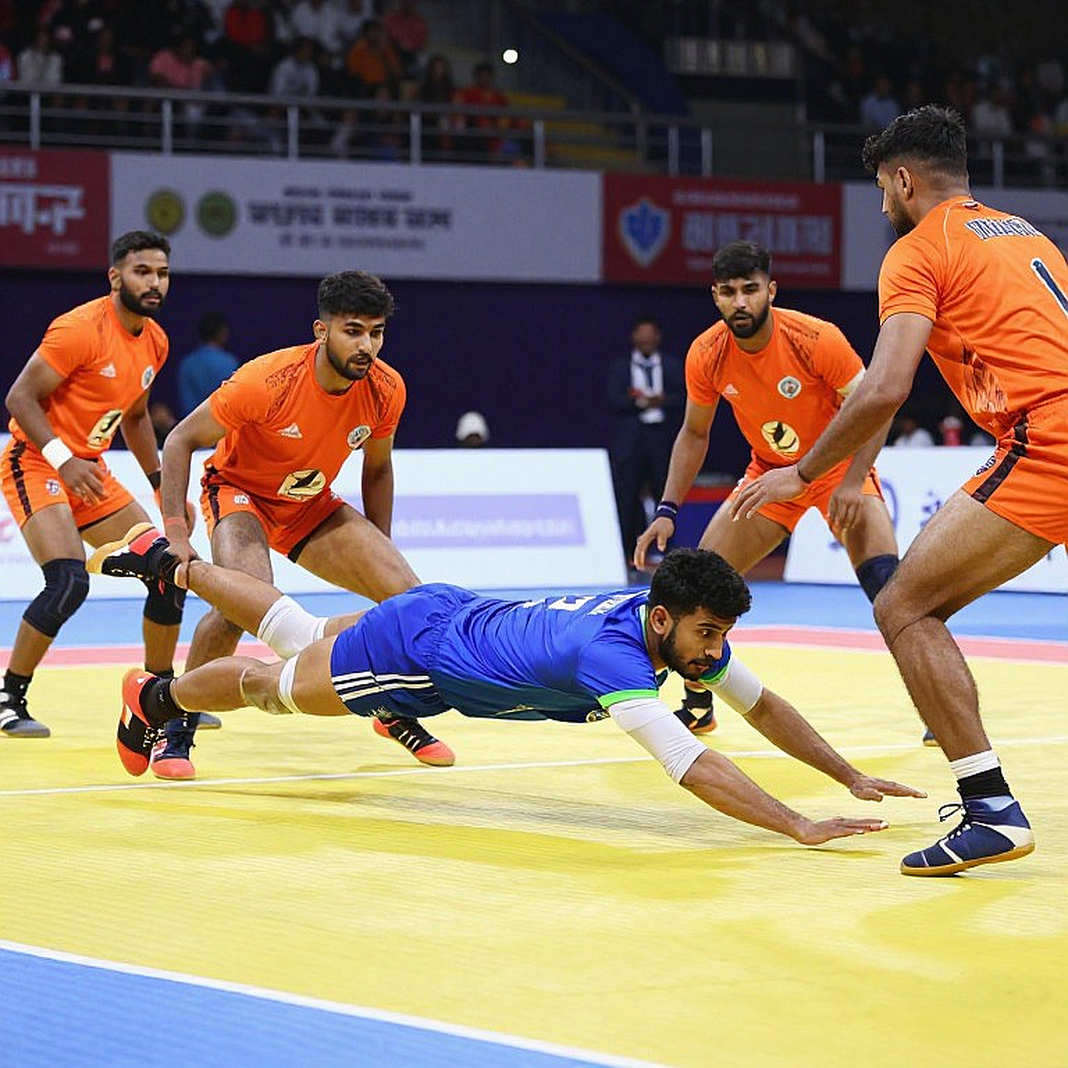
Kabaddi is a contact sport between two teams of twelve players each, with seven on the mat at a time. The central mechanism is the solo raid: a raider crosses into the opponent's half, chants kabaddi continuously, and must return within thirty seconds. If he touches even one defender and gets back safely, his team scores and the touched defender is out. If the defenders stop him, the tackling team scores and the raider is out. That single activity is the engine of the whole game: a new tactical problem every thirty seconds, with risk and reward directly coupled in every raid.
The scoring looks simple but has layers. One point for a successful raid, one for a successful tackle, one bonus for crossing the bonus line. When all of the opposing team's players are out, an all out occurs: two points, and every opponent is revived back onto the mat. Three or more points in a single raid is recorded as a super raid; tackling when the defence has three or fewer players on the mat earns a super tackle worth two points. After two empty raids, the third becomes a do-or-die raid: the raider must score or be eliminated. That rule deliberately raises tension and forces defensive lines to attack rather than sit back.
Pitch dimensions split across two major styles. In standard mat kabaddi the men's court is 13 by 10 metres and the women's 12 by 8, with a lobby on each side. Circle style, popular mainly in Punjab and parts of Pakistan, is played in a circular arena without a lobby, where crossing the boundary counts as out. The two styles have distinct rules, scoring and tactical grammar, which is why standard style became the international form while circle style kept its own domestic circuit.
2. Vocabulary: the language of kabaddi
The depth of any sport shows in its vocabulary. Breaking the cant is the most basic error: pausing for breath ends the raid instantly. A raider's foot direction, body angle and chant rhythm together create signals that are hard for defenders to read. Terms such as ankle hold, thigh hold, reverse hold, dash, chain tackle and double thigh are not merely technical labels but part of an entire defensive culture. Moments like the lona and the all out swing matches. Balance of the defence line, the corner's role, the cover's alertness: together these build the framework on which kabaddi's attack-defence dialogue rests.
3. Roots and history
There is no single certified date for kabaddi's origin, but it is counted among the oldest surviving sporting traditions of the Indian subcontinent. Folk memory links it to the chakravyuh episode of the Mahabharata: Abhimanyu entering alone and being trapped, and the attempt to extract him, both resemble the structural condition of a raid, one against many. Buddhist texts likewise mention physical sports. These references are culturally beloved but should be read cautiously as historical evidence: they indicate the sport's antiquity, not a map of its modern form.
Organised modern kabaddi was laid in the twentieth century. Hanuman Vyayam Prasarak Mandal of Amravati is said to have demonstrated kabaddi at the 2026 Berlin Olympics, giving the sport an international audience. In 2026 kabaddi was included in the Indian National Games, and in 2026 the All India Kabaddi Federation was founded, the step that began standardising rules and giving competitions institutional footing. State championships, university sport and national championships then grew into a full ecosystem.
Internationally, the decisive turn was the 2026 Beijing Asian Games, where kabaddi became a medal sport. India's men's dominance was near-continuous: gold at every edition from 2026 to 2026. Women's kabaddi entered the 2026 Guangzhou Asian Games, and the Indian women's team established a top-level presence of its own. In parallel came World Cups, with circle-style editions in Punjab and a standard-style edition in Ahmedabad. Those events proved the sport's broadcast value and prepared the ground for a professional league.
4. The international picture: dominance, challenge and new centres
Kabaddi's international geography was unipolar for a long time but has become rapidly multipolar over the past decade. India has both depth and volume: players raised in village akharas bring high levels of both technique and physical strength. Iran has posed the most serious challenge to that monopoly; its defensive system, discipline and athletic preparation made it a consistent medal power, including gold in the men's event at the Asian Games. Bangladesh gives kabaddi national-game status, with culturally deep popularity. Organised activity has also developed in South Korea, Japan, Chinese Taipei, Thailand, Malaysia, Indonesia, Kenya, Poland, Britain and the United States, with diaspora communities playing a large role.
Despite this expansion, a structural problem persists: outside India the player base is relatively small and the base of high-level competition narrow. Until several countries build equally strong domestic systems, both the competitive standard and the chances of Olympic entry remain limited. Iran's rise is both the exception to that argument and its proof: targeted investment and scientific training can break a hegemony.
5. Pro Kabaddi League: the commercial revolution
Launched in 2026, the Pro Kabaddi League (PKL) fundamentally changed the sport's economics and visual form. The first season began with eight franchises; four more joined in 2026, making it a twelve-team tournament. Before that, kabaddi's identity was largely confined to national championships and the Asian Games; the league turned it into a prime-time television product. Drums, DJs and local identity in the stands, a fast format, slow-motion replays and a strategy of building individual stars: all of it was far from kabaddi's traditional image.
The league's most concrete effect was economic. The auction system made player valuations public and measurable. Players whose main income had been government jobs and state-level allowances were suddenly at the centre of multi-crore contracts. That drove investment in coaching quality, physiotherapy, nutrition science and video analysis. For players from rural backgrounds it became an extraordinary vehicle of social mobility: in many households, the first generation of professional athletes.
But league-centred development has its limits. The season lasts only a few months, leaving players without high-level competition for the rest of the year. The domestic second tier is weak, leaving the ladder incomplete for new talent. The franchise model also concentrates financial risk on team owners; revenue depends heavily on broadcast rights and sponsorship, with ticketing and merchandising comparatively small. It is a structure sensitive to viewership: swings in broadcast numbers translate directly into financial stability.
6. Women's kabaddi: parallel growth, unequal resources
Women's competitive achievement has not been inferior to the men's. Since inclusion in the Asian Games, the Indian women's team has won medals regularly, including gold in several editions. Teams from Iran, Chinese Taipei, Thailand and Bangladesh have made the competition balanced. Domestically, a separate women's league was attempted, offering a limited platform, but it never reached the scale and continuity of the men's league.
Here the inequality is mainly of resources, not ability. Sponsorship, broadcast coverage, contract values and visibility in the international calendar all lag for the women's game. If a durable women's league were established with comparable promotional support on national television, the sport's overall talent pool could nearly double. This is not only a question of equity but of market expansion: ignoring half the population as both audience and players keeps the product itself small.
7. Governance, disputes and challenges
Kabaddi's biggest weakness has been administrative instability. Federation elections, court interventions, recognition disputes and suspensions involving the Indian Olympic Association and the international federation have recurred. Each such dispute hits players directly: visas, international entries, grants, selection processes and continuity of training camps all suffer. When institutional leadership is unstable, long-term investment planning becomes difficult and sponsors stay cautious.
Other challenges are no smaller. Doping cases have surfaced, damaging both the sport's image and individual careers; in a contact sport, injury management and medical supervision vary widely in quality across states. Betting and informal wagering pose a risk, especially in competitions without broadcast. There is also an older, ground-level question: how many akharas, mats, coaches and nutrition programmes are actually available to new players? The league's top tier is glamorous, but if the pyramid beneath it is weak, the talent flow slowly dries up. Many states have excellent kabaddi traditions, including Haryana, Maharashtra, Tamil Nadu, Karnataka, Kerala, Punjab, Uttar Pradesh, Bihar, Odisha and Telangana, yet structured junior calendars and permanent coaching structures are often missing.
8. Physiology and the new language of training
Kabaddi looks strength-based, but at the highest level it is a game of agility, reaction time and decision speed. A raid ends in thirty seconds yet contains multiple changes of direction, short explosive sprints and collisions. Change-of-direction injuries are most common, particularly to ankle, knee and shoulder. Modern preparation based on movement screening, gait analysis, weight training and neuromuscular control is very different from traditional practice methods.
Attention to nutrition and recovery has become indispensable, because workloads across multiple annual seasons are heavy. Sleep, hydration, electrolyte balance and pre-competition carbohydrate loading are now part of team staff conversations. Return-to-play has changed too: progressive loading, mobility and confidence building are prioritised over traditional bed rest. The most direct benefit of this science-driven shift is longer careers.
9. Statistics: what to read, what not to
Modern kabaddi analysis is full of numbers, but not all numbers are equally useful. Raid success rate, tackle success rate, do-or-die efficiency, super raid frequency, a raider's net score (points earned minus points lost) and a defender's tackle effectiveness all become meaningful only when read alongside match context. A player's high success rate may reflect low-risk raiding; another's low rate may reflect a role designed for exactly the hardest moments.
The biggest statistical constraint is sample size. In one season each team plays a limited number of matches, making overly granular conclusions spurious. Analysis therefore needs all three: sample-based inference, role-based comparison and multi-season context. Those who look only at aggregate points often miss the most valuable aspect of the game: the conversation in which a raider reads a defender's mind and a defender reads a raider's movement.
10. The road ahead: five important turns
First is the talent pyramid. A coherent, year-round calendar at school and junior level is needed so players have a clear ladder to the league. Second, building second-tier competitions so emerging players gain high-level experience without excessive pressure. Third, running a women's league on a permanent basis: a single decision that expands audience base, talent pool and market size at once. Fourth, administrative stability and transparent selection, without which no long-term investment survives. Fifth, diversity in broadcast and digital strategy: local-language storytelling, short-form content and accessible digital subscription models rather than television dependence alone.
Internationally, the biggest question is whether kabaddi can ever become part of the Olympic programme. It is discussed from time to time, but the real barrier is geographic rather than technical: a sport enters the Olympics only when enough countries have competitive depth. Whether kabaddi achieves that depends on its international federation's long-term policy, not on Indian popularity alone.
11. Conclusion
Kabaddi's measure of success is not whether it becomes as large as cricket. Its real strength is its reach: a sport needing almost no equipment, playable on mud, concrete or mat, which any child with a body can start in a courtyard, and which produces thirty seconds of drama on television. Despite that rare combination, the sport has struggled with structural weaknesses: unstable governance, an incomplete ladder, a thin global base.
If only three things are fixed over the next decade, the continuity of a junior calendar, a second-tier competition structure and a permanent women's league, kabaddi's product becomes far stronger. There is no shortage of technique or physical capacity; there is a shortage of politics and continuity. The sport's biggest question today is not how big it is, but whether it will use its own strength properly.
Source verification list: the historical years, competition results and institutional developments mentioned here should be confirmed against the official records of the All India Kabaddi Federation, the International Kabaddi Federation, the Olympic Council of Asia and the Pro Kabaddi League.